“Do You Condemn?”
These three words form a loaded question with epideictic and controversial assumptions that refuse to acknowledge the root cause of the problem of Palestine and how we ended up at this historical point.
Immediately asking if one condemns completely disregards the historical context of the oppression and occupation of Palestine. It’s a question used as a rhetorical tool – to elicit a specific response that serves the questioner’s agenda. The question allows for the presupposement of facts, trapping and narrowing the respondent to a single, oversimplified answer, and forcing them to align with the other’s perspective. As a result, the fallacy of many questions is committed.
No one should support random acts of violence, but we must ask the question about the current optics on display and the war for narrative control.
The question focuses on the selective fetishization and ritual condemnation of violence. This approach deflects from any genuine discussion about the historical context and removes any kind of nuance that would highlight the true character of Israel in all forms.
It is a question posed by the occupier, by those who wish to uphold the system of oppression. It is a question that creates an axis of good or evil that constructs the consciousness of the public. This forces the occupied and oppressed to conform to the occupier’s lexicon, terminology, and narrative.
The question highlights an element of personification that seems to take place when talking about Palestine and Israel. An emotional landscape around Israel’s suffering has developed. However, this landscape is presupposed by the notion that Palestine is not suffering, despite years of harrowing testimonies from Palestinians, extensive research, and fieldwork by Palestinian and non-Palestinian experts.
The question has become a covert way to reset history, separating the October 7 attack from the years of occupation and oppression that preceded it. It is presented as a binary that achieves nothing and leaves no room for a nuanced perspective. The question reinforces the silencing, humiliation, degradation, and ridiculing of the contesting narrative which is very real. Consequently, the convenient narrative that the attack was unprovoked becomes dominant, allowing the other to justify its disproportionate and callous response of indiscriminate collective punishment.
As a result, any answer to the question that isn’t an unequivocal “yes” despite further explanation is met with the accusation of being a “terrorist sympathizer.”
However, responding with a simple “yes, I condemn it” without providing context perpetuates the false narrative that this event occurred in isolation. It compels the respondent to embrace the occupier’s perceived “appropriate” behavioral model when urged to express condemnation. Moreover, such condemnation implicitly endorses Israel’s disproportionate and brutal response, effectively justifying the state’s action.
At the same time, the discussion has veered off course, shifting from the realms of current and historical reality to the realm of moralizing and playing to the gallery.
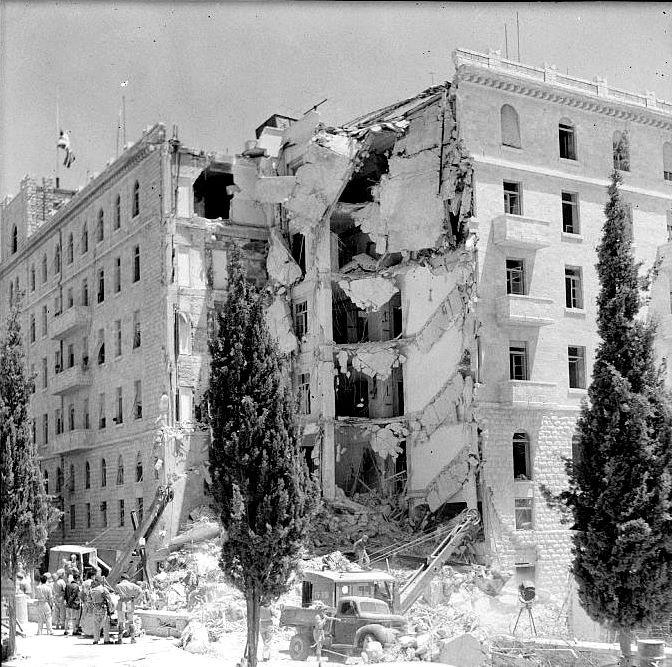
This is intriguing because, at a time when Israel lacked asymmetric power and secure statehood, Zionist paramilitary and militia groups, like the Haganah, Lehi (also known as the Stern Gang) and the Irgun (also known as the Etzel) engaged in insurgency tactics and terror attacks against the British and Palestinian civilians. Notable incidents include the attack on the British Government Broadcasting House in Jerusalem, where an Irgun member disguised as a worker at the station carried three packages of loaded mines and placed them in studio rooms, after which they exploded and killed a technician and another employee on August 2, 1939. The infamous King David Hotel Bombing in July 1946 is another example of a terrorist attack where members of the Irgun planted bombs in milk containers in the hotel’s basement, resulting in an explosion that killed 91 people and injured 476 people. There is also the 1948 Deir Yassin Massacre, one of many attacks against the Palestinians and one that set in motion the Nakba, where members of the Irgun and the Lehi massacred over 100 Palestinians – men, women, and children. Acknowledging that Israel – which rose to power through global support and funding, also committed a string of terror and violent measures to secure its current position, prompts the question: Who is allowed to exercise violence and whose loss of life is more worthy of outrage? The intricate dynamics surrounding these inquiries extend further into the contentious realm of defining resistance. Who holds the authority to delineate the boundaries between legitimate resistance and unacceptable aggression? It sheds light on the intricate interplay of power, morality, and the narratives that shape our collective understanding of conflict and justice.

Aftermath of the King David Hotel Bombing in Jerusalem when the Irgun planted bombs in the hotel on July 22, 1946. Published in the Washington Post in 1946.
How can we ask this question, when Israel continues to exhibit extreme brutality, having even facilitated on-the-ground massacres since its establishment? Examples of this pattern unfolded not only during the ongoing Nakba but also in the 1980s during its second brutal invasion and occupation of Lebanon in 1982, reaching as far as Beirut. Israel’s pretense to halt PLO incursions across its border –who departed a year later to Tunisia– and its 18 year long brutal military occupation of South Lebanon, helped trigger the formation of Hezbollah. The Israelis’ presence in Lebanon often involved tactics that allowed them to distance themselves from direct responsibility by employing Lebanese militias, evident in the case of the torture of prisoners in the Khiam detention center, controlled by the South Lebanon Army, Israel’s proxy militia, which was provided professional guidance and training by Israel. They also backed the Phalangist militia in the Sabra and Shatila massacre that killed between 2000-3500 Palestinian refugees and Lebanese civilians over a span of two days.
Moreover, Palestinian casualties are frequently attributed to collateral damage or worse, labeled as terrorists.
While civilians killed by artillery in a war zone may or may not differ categorically from those assaulted, tortured, raped, and executed by ground forces, the narrative conveniently omits a crucial point. Israeli forces, when their situation and power position may have been more desperate, and their reputation was not yet centered on maintaining the appearance of civility, employed similar tactics, albeit rooted in goals not pertinent to liberation, but in operations of ethnic cleansing of Palestinians.

Palestinian refugees making their way from Galilee in October-November 1948. Photo by Fred Csasznik for the front cover of The Birth of the Palestinian Refugee Problem by Benny Morris, Cambridge University Press 1989. Pictures sourced from Wikimedia
Not all can condemn the attacks based on the Western premise that they are an illegitimate form of retaliation by an oppressed people, especially when peaceful methods have been exhausted. The British used similar tactics as the Israelis in its war on words against the IRA in an effort to minimize the resistance during the war for Irish independence.
Condemning both sides seeks to minimize or even excuse the history of Israeli war crimes that predate Hamas.
Imagine building a concentration camp, tightly confining and subjecting its prisoners to extreme conditions, and then demanding people to condemn it when it inevitably explodes, despite the members of the occupying state expressing genocidal intentions. In the current times, the world has forgotten what resistance looks like before the word “terrorism” came into use. It’s completely illogical.
Whether one criticizes Hamas or not is inconsequential; for it holds no significance nor does it matter.

Amar Mustafa
Amar Mustafa is a historian and researcher, focusing on the Arab Left, working-class, and labor history within the Levant region. As a first-generation Australian, she was born to a Lebanese mother and a Syrian father. Amar earned her Bachelor of Arts with honors from Monash University, dedicating her research to examining Lebanon's state-labor relations within the institutional and legal framework from 1946 to 1975.
Currently, she is actively pursuing a Master's degree in International Relations at Monash University, Australia, specializing in Political Violence and Counter-terrorism. Alongside her academic pursuits, Amar passionately maintains a blog titled "Ya Banat," where she documents and highlights the rich tapestry of women's history across the MENA Region.
- This author does not have any more posts.